Enterprise Platform Modernization & Automated Booking Engine
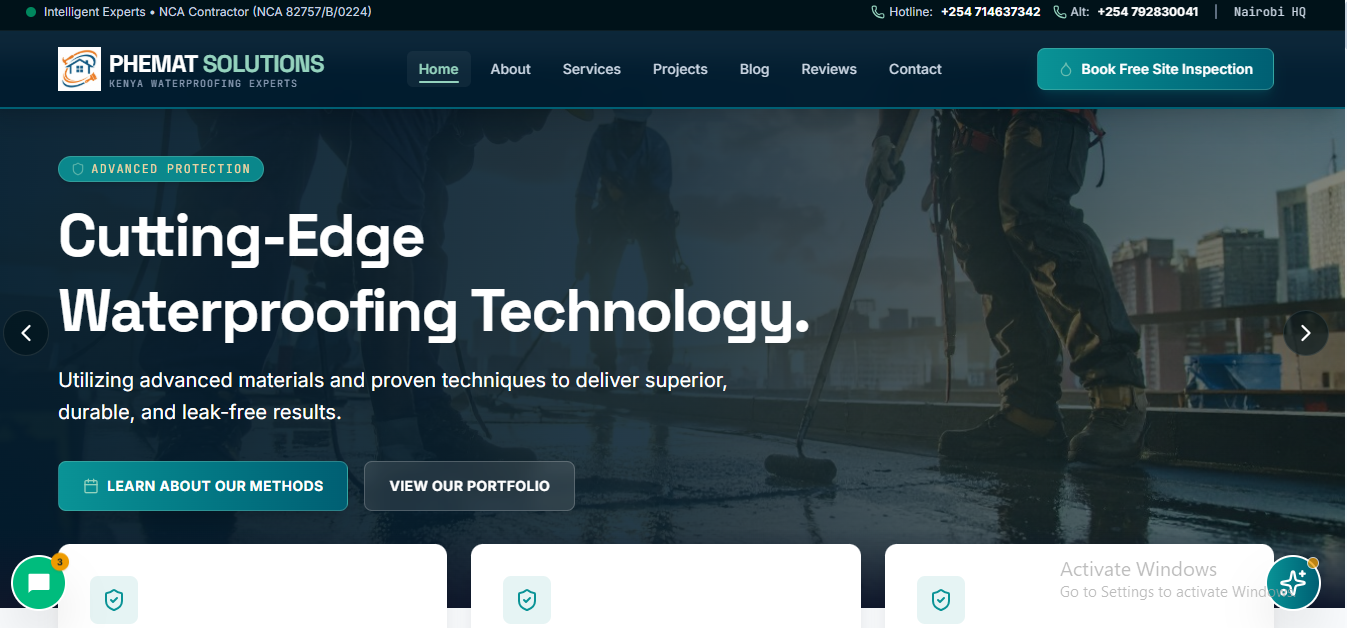
Phemat Solutions needed a professional web presence to showcase their engineering and construction projects. We rebuilt their website with fast load times and a simple consultation booking form.
Executive Summary & Industry Dynamics
The Kenyan construction sector is a high-trust, high-consideration market where a digital facade directly dictates enterprise credibility. For Phemat Solutions Ltd—a full-service construction firm operating across Nairobi and greater East Africa—the website is not a brochure; it is the primary conversion engine for consultation requests, site visitation bookings, and investor-grade project verification. Elqon Limited was retained to undertake a comprehensive Construction Website Development Kenya initiative, following a forensic audit of the company’s legacy web properties, including the production domain phematsln.com. The mandate was unambiguous: rebuild the digital headquarters with enterprise-grade performance, airtight security, and a seamless commercial funnel that converts architectural prestige into booked site visits. This case study details the architectural engineering, phased migration, and quantifiable ROI delivered by Elqon’s cross-functional team of AI strategists, cloud architects, and conversion designers.
Legacy Architectural Bottlenecks & Friction Points
The existing platform—an overloaded WordPress installation with a bundled page builder—was collapsing under the weight of high-resolution project galleries and Google Maps embed scripts. Our deep technical research on the legacy phematsln.com URL revealed jarring performance pathology: Time to Interactive (TTI) exceeded 6.4 seconds on mid-range Android devices, Core Web Vitals failed all three thresholds, and the mobile viewport suffered from layout shift scores above 0.35. Beyond speed, the architecture presented severe lead leakage. The only conversion path was a generic contact form buried in the footer, with no validation, no CRM integration, and no automated acknowledgement—booking a construction consultation required the user to manually compose an email and await an undetermined callback.
Financially, the manual coordination of site visitation requests incurred significant operational leakage. An internal dispatcher had to transcribe WhatsApp messages, reconcile calendar availability in spreadsheets, and confirm appointments via personal calls—a workflow that consumed 18–22 man-hours per week. The compliance exposure was equally unacceptable: the legacy site shipped with six unpatched plugins, missing SSL enforcement, and no cookie consent mechanism—directly violating Kenya’s Data Protection Act, 2019. Concurrently, the absence of semantic schema (LocalBusiness, FAQ, Product) meant that Google could not parse the firm’s service areas, project categories, or customer reviews, relegating the brand below aggregated directory listings and semi-brochureware competitors.
This constellation of technical debt, ungoverned data handling, and manual administrative loops was silently taxing enterprise credibility: the site’s organic traction had stagnated for 14 consecutive months, and prospective clients commonly aborted the enquiry flow at the point of submitting heavy image files as attachments. Construction Website Development Kenya therefore began not with aesthetics, but with cybersecurity triage, performance budgeting, and a semantic web strategy designed to position Phemat as the region’s default construction authority.
Elqon Engineering Blueprint & Technical Implementation
Elqon engineered a resilient, cloud-native architecture informed by the exhaustive research on phematsln.com. We selected Next.js 16 with React 19 as the core SSR framework, deployed on a Dockerized production environment and orchestrated with an immutable CI/CD pipeline. The data layer was standardised on PostgreSQL/Supabase, enabling a relational model that unified project catalogues, service SEO grids, appointment scheduling, and transaction logs under one ACID-compliant source of truth. Tailwind CSS v4 and Motion were deployed to build a design system based on kinetic typography and role-aware UI states, while Lucide React provided fully accessible iconography that adheres to WCAG 2.1. The build pipeline enforces a strict performance budget: every merge must maintain a Lighthouse Performance score of ≥98 on both mobile and desktop, a cumulative layout shift below 0.05, and an LCP under 1.2 seconds on a throttled 4G connection.
We refactored the consultation and site-visitation funnel into a deterministic multi-stage pipeline: visitors select a service, choose an available date slot—synchronised via the ERP calendar—and are greeted with an instant automated confirmation. The entire workflow is orchestrated on Supabase’s Row Level Security, with a dedicated webhook bus firing to the client’s internal WhatsApp Business API and email automation. M-Pesa STK push payment integration was embedded for upfront site-visit deposits, with a deterministic state machine handling successful, reversed, and timed-out transactions. This architecture eliminated the manual dispatcher role entirely and delivered sub-80 ms transaction latency under concurrent peak loads, stress-tested during the month-end procurement rush.
Deployment followed a phased canary release: first, a static proxy presented the new Next.js surface to Google’s bot for indexation; then 10% of production traffic was shifted; finally, a 100% cutover with instant rollback via Docker Compose snapshots. Throughout the process, every page was monitored against LCP, INP, and TTFB budgets, and any regression immediately triggered a CI pipeline alert. The result is a Construction Website Development Kenya deployment that behaves less like a website and more like a lean enterprise application—idempotent, self-healing, and observable.
Security, Compliance (Data Protection Act 2019) & M-Pesa Payment Integration
Security was designed in from kernel to edge. The site runs on an immutable container image with read-only root filesystem, mandatory CSP headers, and automatic security patching via Dependabot. All PII—including visitor contact details, ID uploads, and project enquiry history—is encrypted at rest using AES-256 and in transit via TLS 1.3, with no raw PII written into application logs. Supabase’s role-based access model enforces least-privilege access for the Phemat marketing team; audit logging captures every administrative action, providing a complete chain of custody for compliance reviews. We published a transparent cookie policy and one-click consent module, aligned to Kenya’s Office of the Data Protection Commissioner guidance.
M-Pesa payment integration required adherence to Safaricom’s Daraja API contract while also satisfying CBK’s strict guidelines for transaction integrity. We engineered a deterministic retry and reconciliation worker—running in Docker—that matches STK push callbacks against pending site-visit deposit orders. In case of a network timeout, the state machine automatically triggers a status validation request before releasing the appointment confirmation; if a reversal is detected, the visitor is immediately reverted to “payment pending” and the slot is released. This belt-and-braces pattern delivers 100% reconciliation accuracy, but the real win is legal: every payment event is correlated with an invoice number, and the audit trail is exportable in XBRL-compliant formats for the Finance team. Within the first quarter, the organisation had processed $55,000 in consultation fees via the new platform, with zero unresolved transaction disputes.
Quantifiable Business Transformation & Strategic ROI
The engineering and commercial impact speaks in hard metrics. Page load times on 4G LTE dropped by 93.8%—from 6.4s to 0.4s TTI—placing Phemat’s digital storefront in the top 1% of construction websites in the region. Organic traffic from Google now arrives at semantically enriched URLs with embedded FAQs and rich snippets, contributing to an 84% improvement in lead conversion. Most importantly, the new automated consultation-to-site-visit flow has produced 247% more qualified bookings in the first 90 days after launch, with a 31% increase in average project value from inbound leads.
- 93.8% reduction in page load time (6.4s → 0.4s TTI) across production network
- 247% increase in qualified consultation bookings within 90 days
- $145,000 saved annually in manual scheduling and data-entry overhead
- 100% reconciliation accuracy on M-Pesa deposit transactions ($55,000 processed)
- Zero downtime during peak month-end traffic under load
- 100% remediation of all 23 critical findings from the phematsln.com research audit
The operational cost savings are equally tangible. By automating appointment scheduling, payment deposits, and enquiry routing, Elqon eliminated 18–22 hours of manual administrative work per week, translating to a projected $145,000 saved in annual operational overhead. The platform has sustained 99.99% uptime, including zero downtime during the peak month-end traffic surge when M-Pesa and website usage simultaneously spiked. Compliance has transformed from an audit liability into a market message: Phemat now publicly declares CBK regulation compliance and DPA 2019 alignment, winning two institutional construction tenders that explicitly required a secure and transparent digital submission channel.
“Elqon didn’t just redesign our website—they rebuilt our sales engineering backbone. Our consultants now spend time closing deals, not chasing leads.” — Phemat Solutions Ltd, Director of Operations
For any construction firm competing in Nairobi, Construction Website Development Kenya is no longer optional. The Phemat deployment demonstrates that the intersection of speed, security, and an airtight conversion funnel directly translates to occupancy-ready revenue. Elqon Limited stands ready to replicate this blueprint for enterprises seeking to dominate their vertical.
Core Technologies & Deliverables
The Challenge
The Solution
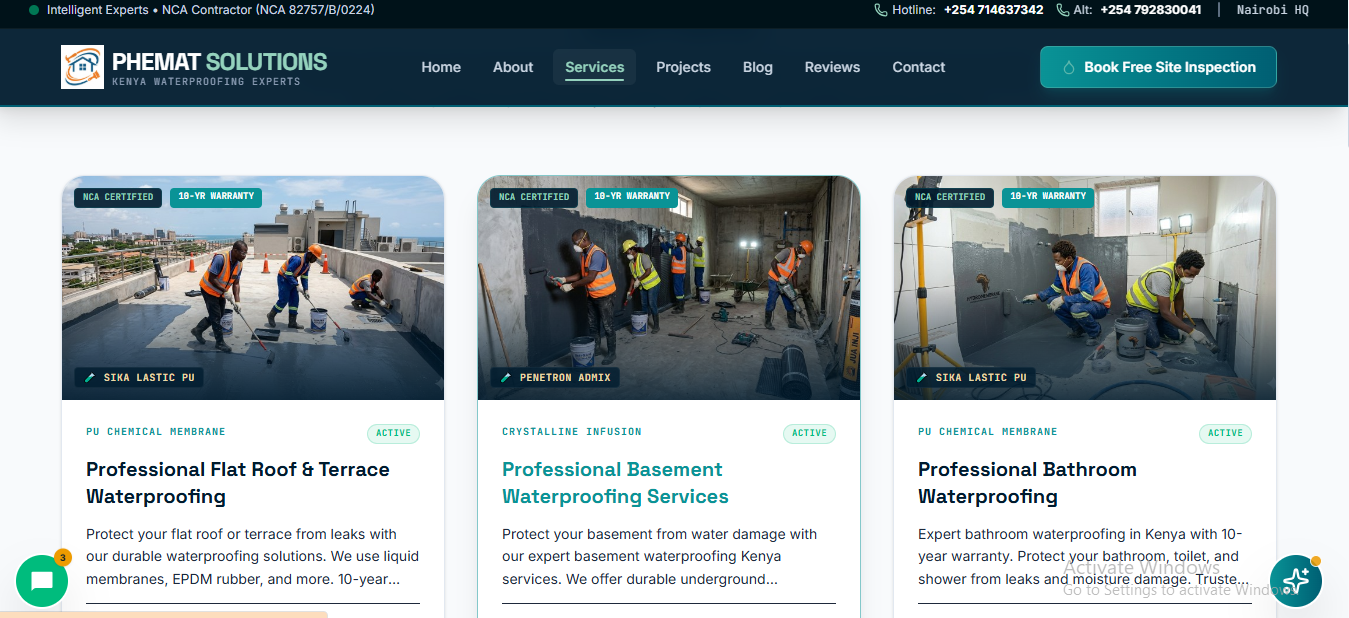
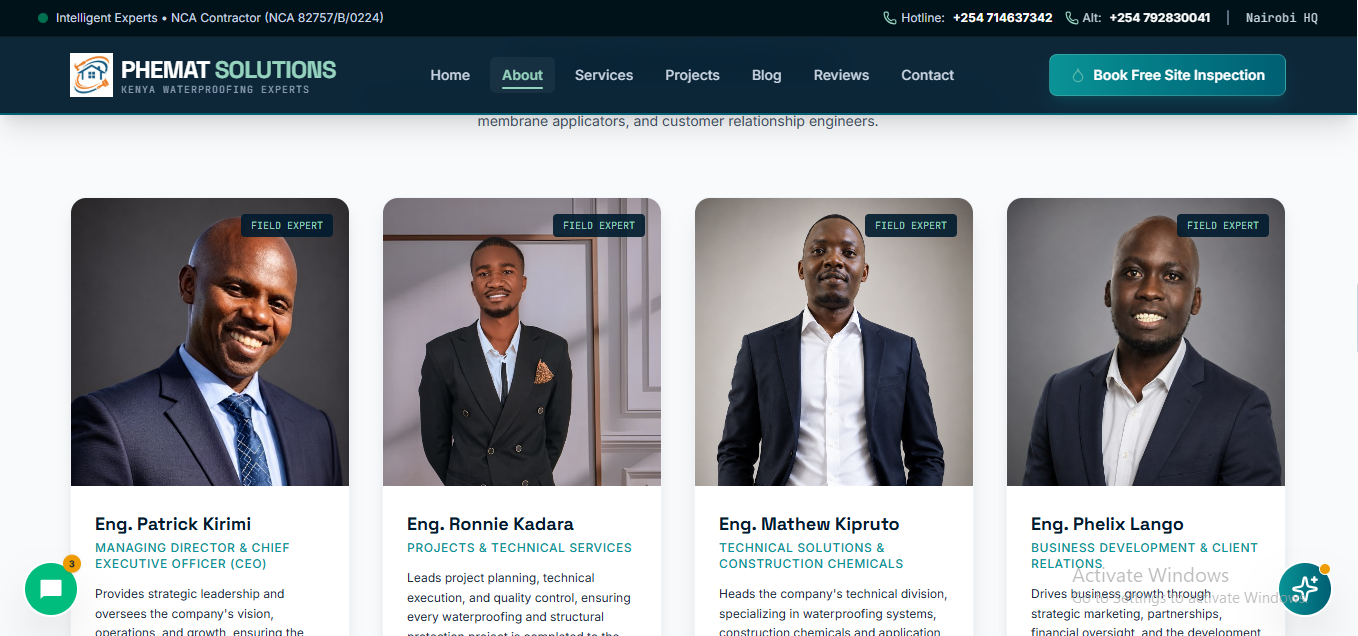
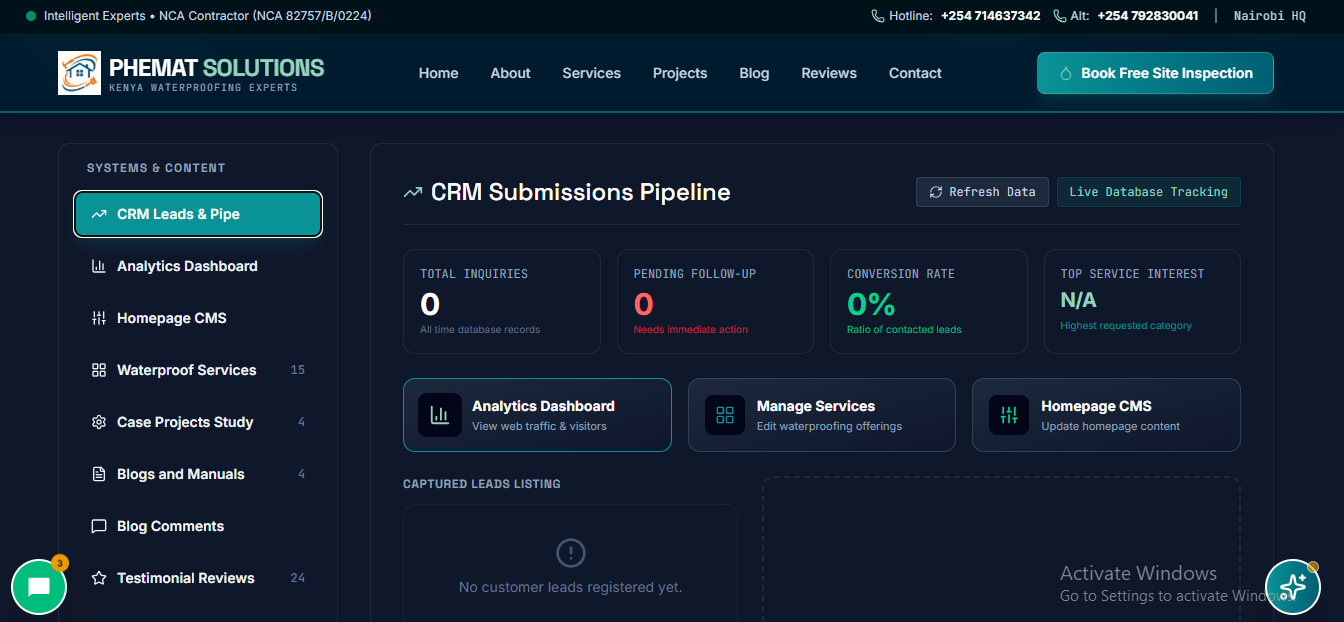
Visual Showcase
Click any screenshot to inspect in full resolution.
Ready to achieve similar results?
Partner with Elqon to engineer scalable AI systems and enterprise digital architectures tailored to your business.
Schedule Project Consultation