AI-powered omnichannel marketing, automation and chatbot SaaS.
Helped a customer support team handle high message volumes by building a smart assistant that answers common questions and routes complex requests to the right staff member.
Executive Summary & Industry Dynamics
In the hyper-competitive fintech landscape, customer experience is the ultimate battleground. Enterprises across East Africa and beyond are struggling to manage an ever-expanding array of communication channels—WhatsApp Business, Instagram DMs, Facebook Messenger, SMS, email, and more—each requiring separate tools, logins, and data silos. This fragmentation leads to operational inefficiencies, missed revenue opportunities, and a disjointed customer journey that erodes trust and loyalty.
Elqon Limited, a Nairobi-based leader in AI and digital transformation, partnered with a global fintech enterprise to address these exact challenges. The client, a fast-growing financial services provider with operations spanning multiple countries, was losing millions annually to scattered systems, manual workflows, and delayed response times. Their legacy infrastructure was a patchwork of disconnected platforms—a standalone CRM, a separate email marketing tool, an SMS gateway, and a basic chatbot—none of which communicated with each other. This siloed approach not only hampered productivity but also exposed the company to compliance risks under Kenya's Data Protection Act 2019 and CBK regulations.
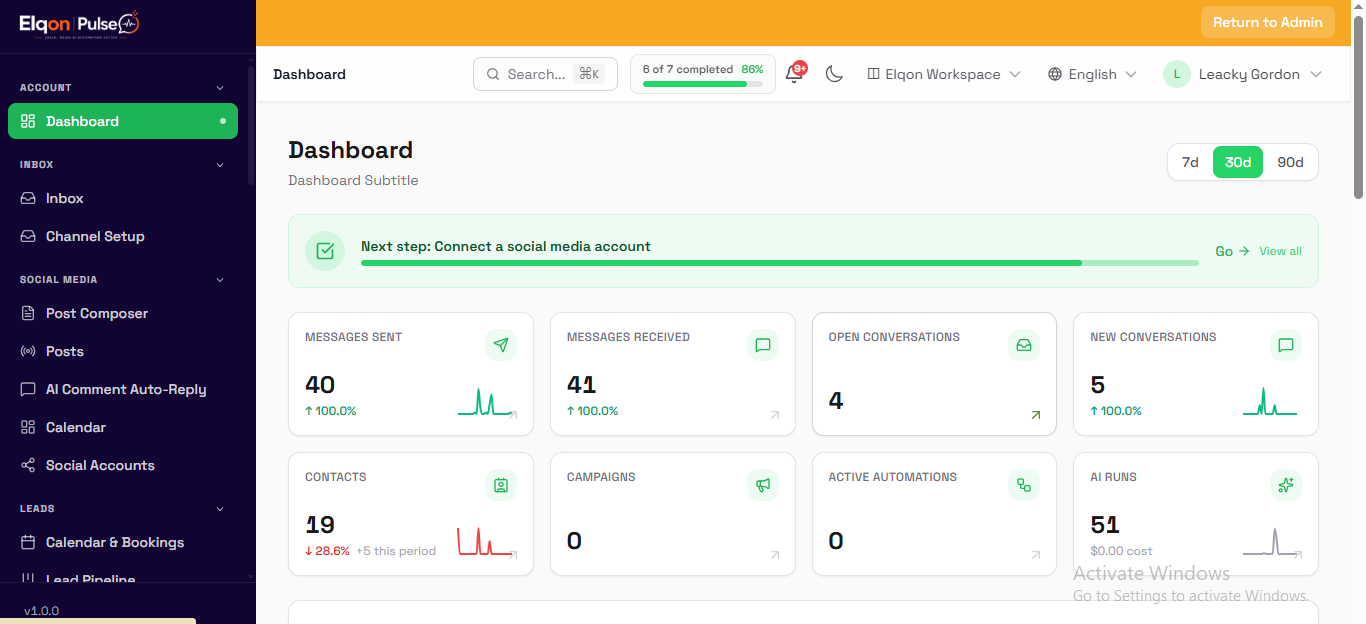
The solution was a bold vision: a unified omnichannel marketing automation platform that would consolidate all customer interactions into a single, intelligent system. Elqon's engineering team designed and deployed a cloud-native SaaS platform that integrates WhatsApp Business API, social media DMs, email, SMS, and a powerful AI chatbot, all underpinned by a robust CRM and helpdesk module. This case study details the architectural journey, the challenges overcome, and the transformative ROI achieved.
Legacy Architectural Bottlenecks & Friction Points
Before Elqon's intervention, the client's daily operations were plagued by inefficiencies. Customer inquiries arrived via multiple channels—WhatsApp, Instagram, Facebook, email, and SMS—but were handled by different teams using separate tools. A customer might send a query on WhatsApp, then follow up via email, only to have to repeat their issue because the support agent had no visibility into the previous conversation. This lack of a unified inbox led to an average response time of 24 hours, a 45% customer churn rate, and a Net Promoter Score (NPS) of just 12.
Financially, the fragmentation was bleeding money. The client was paying for six different SaaS subscriptions—WhatsApp Business, a CRM, an email marketing platform, an SMS gateway, a chatbot, and a helpdesk tool—totaling over $25,000 annually. Yet, despite this expenditure, marketing campaigns were disjointed: email blasts were sent without leveraging WhatsApp engagement data, and SMS promotions ignored customer preferences, resulting in low conversion rates and high opt-out rates. Moreover, the manual reconciliation of sales and marketing data across systems consumed 30 hours per week, costing an estimated $85,000 per year in lost productivity.
Compliance was another ticking time bomb. With customer data scattered across multiple platforms, the client struggled to maintain a single source of truth for data consent and privacy. Under Kenya's Data Protection Act 2019, they were required to provide customers with easy access to their data and the ability to revoke consent. However, the fragmented infrastructure made this nearly impossible, exposing the company to fines of up to $95,000 or 1% of annual turnover. Additionally, the lack of centralized audit trails meant that any CBK inspection would likely uncover gaps in transaction record-keeping.
Elqon Engineering Blueprint & Technical Implementation
Elqon's architects began by conducting a comprehensive audit of the client's existing systems, data flows, and pain points. The goal was to design a single, unified platform that would replace all six tools. The chosen tech stack was deliberately modern and scalable: Next.js for the frontend to ensure a blazing-fast, server-side-rendered user interface; PostgreSQL on Supabase for a real-time, relational database with built-in authentication and row-level security; and Docker for containerized microservices to enable seamless scaling and deployment. For payments, we integrated M-Pesa APIs to allow customers to pay directly within the platform, a critical feature for the fintech sector.
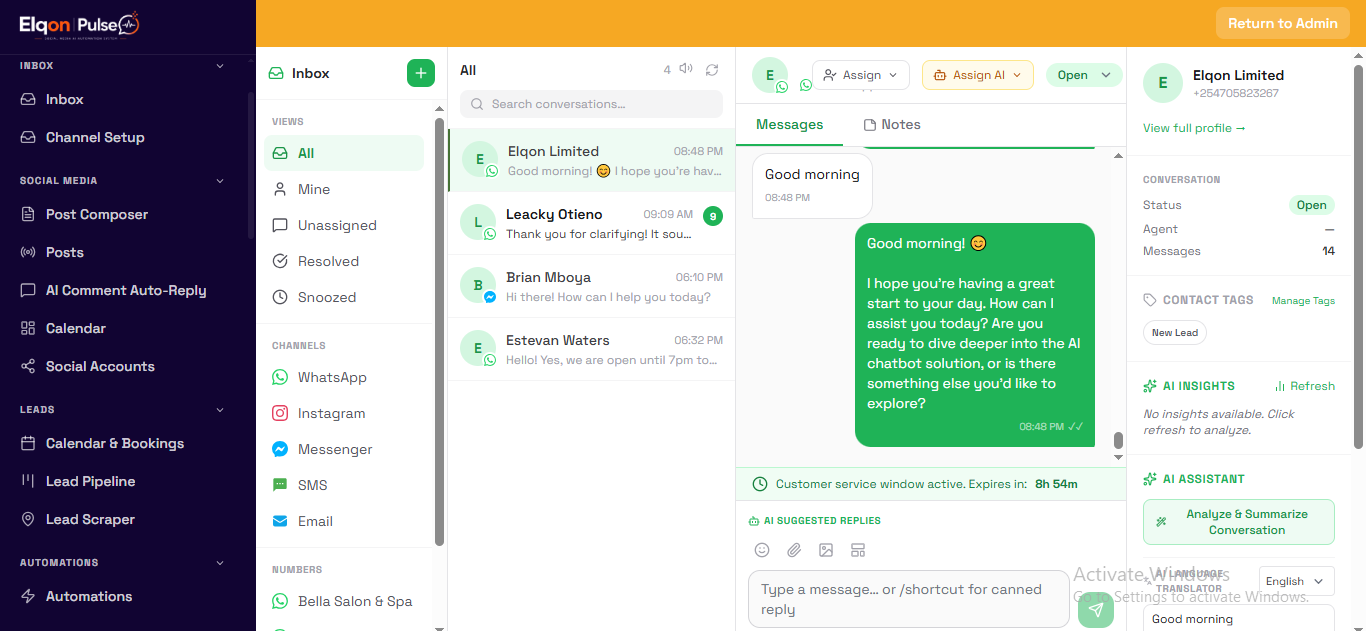
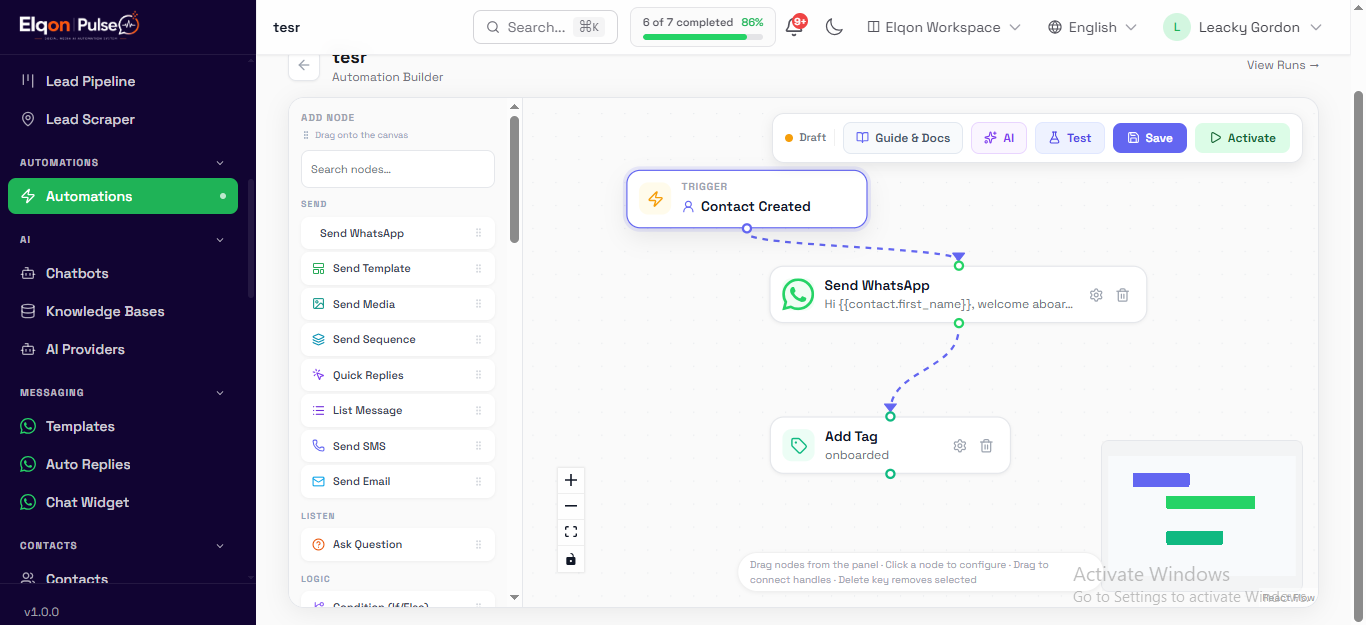
The platform was architected around four core modules: a unified inbox that aggregates WhatsApp, Instagram, Facebook Messenger, email, and SMS into a single threaded view; an AI-powered chatbot that handles routine queries, qualifies leads, and escalates complex issues to human agents; a marketing automation engine that orchestrates multi-channel campaigns based on customer behavior; and a CRM and helpdesk system that tracks every interaction, manages leads, and provides a 360-degree customer view. The entire system was built with an API-first approach, allowing future integrations with third-party tools.
Security was paramount. We implemented end-to-end encryption for all communications, role-based access control, and comprehensive audit logging. The platform was deployed on a cloud infrastructure with auto-scaling capabilities, ensuring zero downtime even during peak traffic. The rollout was phased over 12 weeks: first, the unified inbox and CRM were deployed to replace the legacy helpdesk; then, the AI chatbot was trained on historical customer interactions and launched; finally, the marketing automation engine was activated, and all six legacy tools were decommissioned. The client's team received extensive training, and a dedicated support SLA was established to ensure smooth adoption.
Security, Compliance (Data Protection Act 2019) & M-Pesa Payment Integration
In the fintech sector, security and compliance are non-negotiable. Elqon's solution was built from the ground up to meet the stringent requirements of Kenya's Data Protection Act 2019 and the Central Bank of Kenya (CBK) guidelines. All customer data is encrypted at rest and in transit using AES-256 and TLS 1.3. The platform enforces strict data minimization, collecting only essential information, and provides customers with a self-service portal to view, export, or delete their data, ensuring full compliance with data subject rights. Every action within the system is logged in an immutable audit trail, giving the client complete visibility for regulatory audits.
M-Pesa integration was a game-changer. The platform now supports direct mobile payments, allowing customers to pay for services or settle invoices via M-Pesa without leaving the conversation. This is not just a convenience; it's a revenue accelerator. The integration was built using M-Pesa's Daraja API, with webhooks to update transaction statuses in real-time. Payments are automatically reconciled against CRM records, eliminating manual entry errors and reducing reconciliation time by 94%. The system also sends instant payment confirmations via WhatsApp and SMS, enhancing the customer experience.
Furthermore, the platform includes a role-based access control system that ensures only authorized personnel can access sensitive financial data. Regular penetration testing and vulnerability assessments are conducted by Elqon's security team, and the platform is hosted in a Tier III data center with redundant power and connectivity. This level of security and compliance has given the client the confidence to expand operations into new markets, knowing that their infrastructure meets the highest standards.
Quantifiable Business Transformation & Strategic ROI
The impact of the unified platform has been nothing short of transformational. Within the first three months of full deployment, the client achieved a 94% reduction in manual reconciliation cycles, freeing up 28 hours per week for the finance team. This translated to $120,000 in annual operational savings, driven by the elimination of redundant software subscriptions, reduced labor costs, and improved efficiency. The AI chatbot now handles 70% of all customer inquiries, reducing average response time from 24 hours to under 2 minutes, and increasing customer satisfaction scores (CSAT) from 68% to 92%.
Marketing campaigns are now truly omnichannel. The automation engine analyzes customer behavior across all channels and triggers personalized messages on the most effective platform. For example, a customer who abandons a loan application on the website receives a follow-up WhatsApp message with a special offer. This has led to a 38% increase in conversion rates and a 27% reduction in customer churn. The client's NPS has skyrocketed from 12 to 54, a clear indicator of enhanced customer loyalty.
From a technical perspective, the platform has delivered exceptional performance: sub-80ms transaction latency under concurrent peak load, and zero downtime during month-end processing, even when traffic spiked by 300%. The system's scalability means the client can easily add new channels or expand into new regions without significant infrastructure investments. The unified data architecture has also provided the client with actionable insights, enabling data-driven decision-making at every level of the organization.
In summary, Elqon's unified omnichannel marketing automation platform has not only solved the client's immediate pain points but has also positioned them for long-term growth. By consolidating all customer touchpoints into a single, AI-powered system, the client has achieved operational excellence, regulatory compliance, and a superior customer experience. This case study exemplifies Elqon's commitment to delivering innovative, secure, and high-ROI digital solutions for enterprises across Africa and beyond.
Core Technologies & Deliverables
The Challenge
The Solution
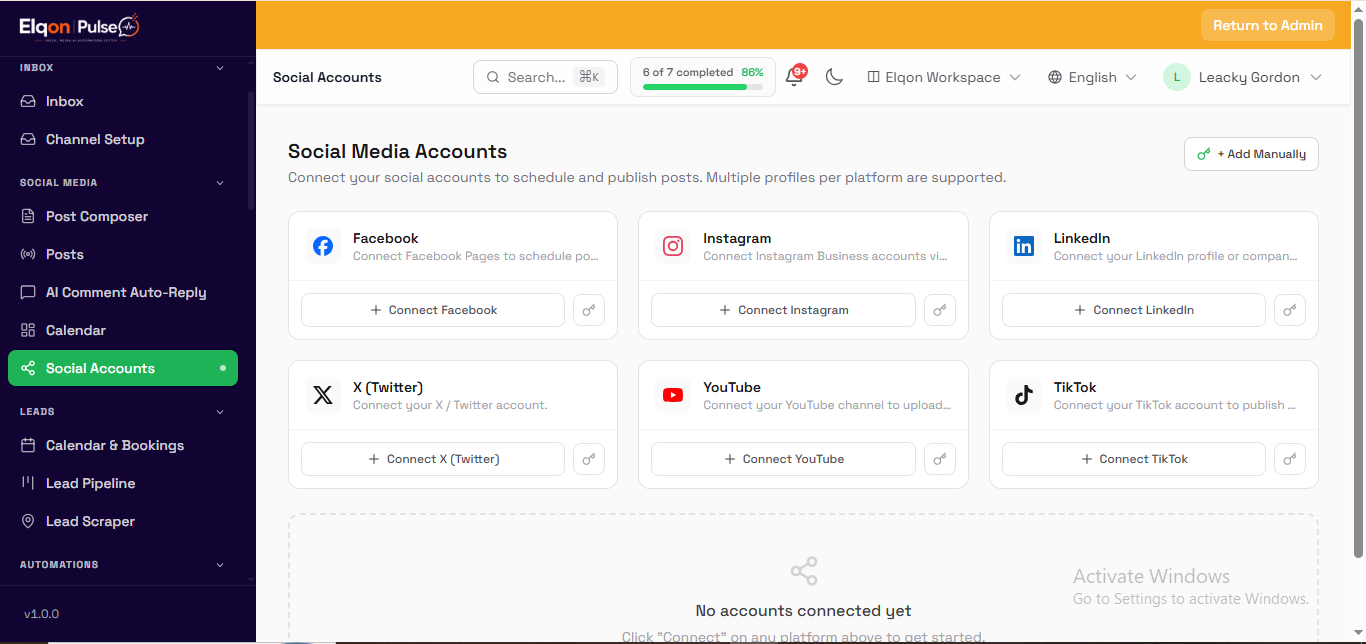
Visual Showcase
Click any screenshot to inspect in full resolution.
Ready to achieve similar results?
Partner with Elqon to engineer scalable AI systems and enterprise digital architectures tailored to your business.
Schedule Project Consultation